AI Trading vs Algorithmic Trading: What Actually Differs
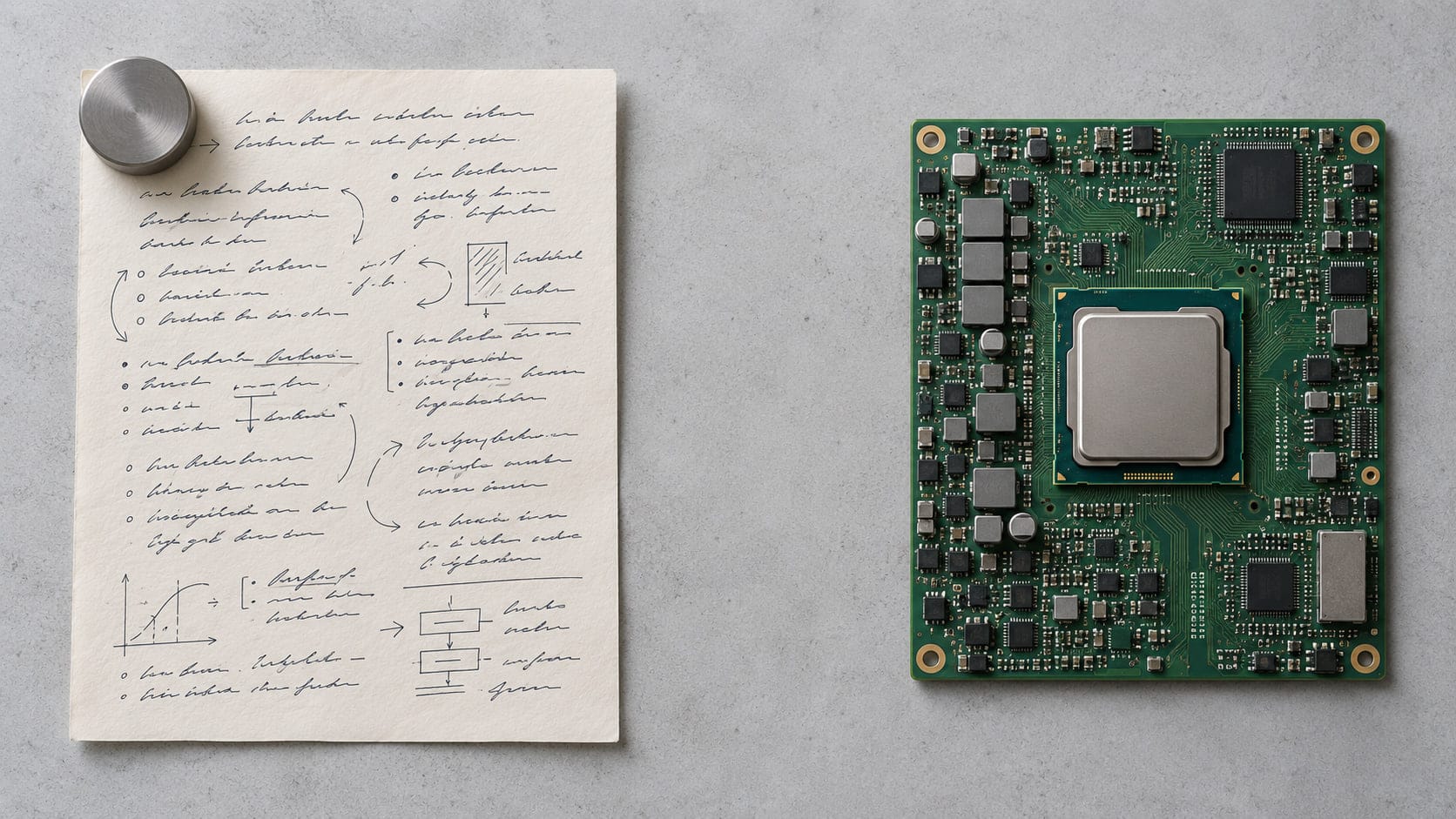
The order that reaches the broker looks identical either way. What differs is whether anyone can read the logic that produced it.
Key takeaways
- Automation is not the difference. Both approaches end in software placing an order.
- In algorithmic trading the logic is preset: written or assembled by a person, then compiled before it can run.
- MetaQuotes describes trading robots as undertaking price analysis based on preset algorithms.
- In a fitted model the logic is learned from data, which is why nobody can fully state why a given output appeared.
- Neither approach is shown to outperform the other by anything we have read, and this article does not rank them.
In this article · 5 sections
The short answer
Both put software between you and the order. That is the similarity, and it is the thing most comparisons mistake for the difference.
The actual distinction is how the decision gets made. In algorithmic trading, a person decides the logic in advance and writes it down; the computer carries it out. In the machine-learning tools marketed as AI trading, the logic is fitted to historical data; the computer derives it, and the person who deployed it cannot fully state what it is.
Same order arriving at the broker. Very different question when you ask "why did it do that?"
What "algorithmic" means in practice
Platform documentation is useful here because it describes a real, specific implementation rather than a concept. MetaQuotes describes what a trading robot does on MetaTrader 5:
"Trading robots undertake price analysis based on preset algorithms, decision-making and, as a result, execution of trading operations in the market."
Preset is the operative word. The analysis follows a procedure fixed before the market opened. The platform provides a language for expressing it:
"The trading platform has its own built-in language for programming trading strategies MetaQuotes Language 5"
and the strategy must be compiled before it can run at all:
"compile it by pressing F7 to receive an executable file. The executable file has an extension EX5 and can be run in the trading platform."
There is also a no-code path, and it matters for this comparison because its existence undercuts the lazy framing that rule-based means technical and AI means accessible:
"With the MQL5 Wizard a trader without programming skills can easily create Expert Advisors. You only need to select trading signals for an Expert Advisor, as well as money management and trailing stop algorithms."
Even here the logic is selected, not learned. The trader picks from defined components. Someone could, in principle, read back exactly what the resulting system will do.
The mechanics of running one are covered in what expert advisors actually do.
What differs in a fitted model
A machine-learning tool inverts the order of operations. Instead of stating the rule and applying it to data, it is given the data and adjusts internal parameters until its outputs match what happened. The resulting function is the product of that fitting, not of anyone's reasoning.
Three consequences follow, and they are the real content of this comparison.
Readability. A preset algorithm can be read. A fitted model's parameters can be inspected but not meaningfully explained — there is no sentence that says why this input produced that output, only a very large arithmetic that did.
Failure mode. A rule fails when conditions fall outside what its author imagined, which is at least diagnosable afterwards. A model can fail because the new data differs from its training data in ways nobody noticed — and that failure is both harder to see coming and harder to attribute after the fact. The strongest evidence we have read on this is a fifteen-model benchmark where every model degraded on data it had not seen, discussed in what the research shows.
Where overfitting bites. Both are vulnerable, but differently. A rule set gets overfitted by a human trying variations until one looks good. A model can overfit on its own, at scale, during training. Either way the mechanism is the same and it is covered in why good backtests fail live.
What this comparison cannot tell you
It cannot tell you which performs better. Nothing we have read compares the two approaches head to head, and we are not going to produce a verdict by assembling one from fragments. Vendors do exactly that, in both directions, and it is not an argument.
Two more things we are deliberately not claiming. We are not saying AI tools "output probabilities" as a general rule — that is a plausible description of some systems, we have no source establishing it across the category, so it is not stated as fact here. And we are not treating "algorithmic" as a synonym for simple: a preset algorithm can be extremely sophisticated and still be entirely readable.
The practical version
When a tool is in front of you, one question separates the two:
Can someone state the rule the tool is following, in words, before it runs?
If yes, it is algorithmic in the sense above, whoever wrote it and however it was assembled. If no — if the answer is that it learned from data — then you are trusting a fitting process, and the questions worth asking are about what data it was fitted on and whether it has been tested on anything else. Our framework for the categories of AI tool sets out how to tell which you are looking at, and the risk disclosure covers the limits of all of it.
Sources and references
- How to Create an Expert Advisor or an Indicator — MetaTrader 5 Help — MetaQuotes Ltd.Official documentation · retrieved 5 October 2026
- Algorithmic trading, trading robots — MetaTrader 5 Help — MetaQuotes Ltd.Official documentation · retrieved 5 October 2026